
A child misses the same move three classes in a row, and you can see the frustration rising before they say a word. Their shoulders tighten. Their face changes. They look around to see who got it faster. That moment is exactly where how martial arts teaches perseverance becomes real. Not in a speech, not in a slogan, but in the decision to take a breath, reset, and try again.
Parents usually do not come looking for perseverance as an abstract idea. They come because something is not clicking. Their child gives up quickly. Melts down when something feels hard. Avoids challenge. Starts things with excitement, then wants out as soon as progress slows down. That can show up at school, at home, in sports, and even in friendships.
Perseverance matters because life keeps asking for it. A tough assignment, a hard conversation, a bad game, a disappointing result – none of those are rare. What helps a child long term is not being protected from every hard moment. It is learning they can stay steady inside one.
How martial arts teaches perseverance in real life
Martial arts has a way of making effort visible. A child cannot fake a stance they have not practiced. They cannot skip repetitions and somehow perform with confidence under pressure. Progress has to be earned in public, one class at a time.
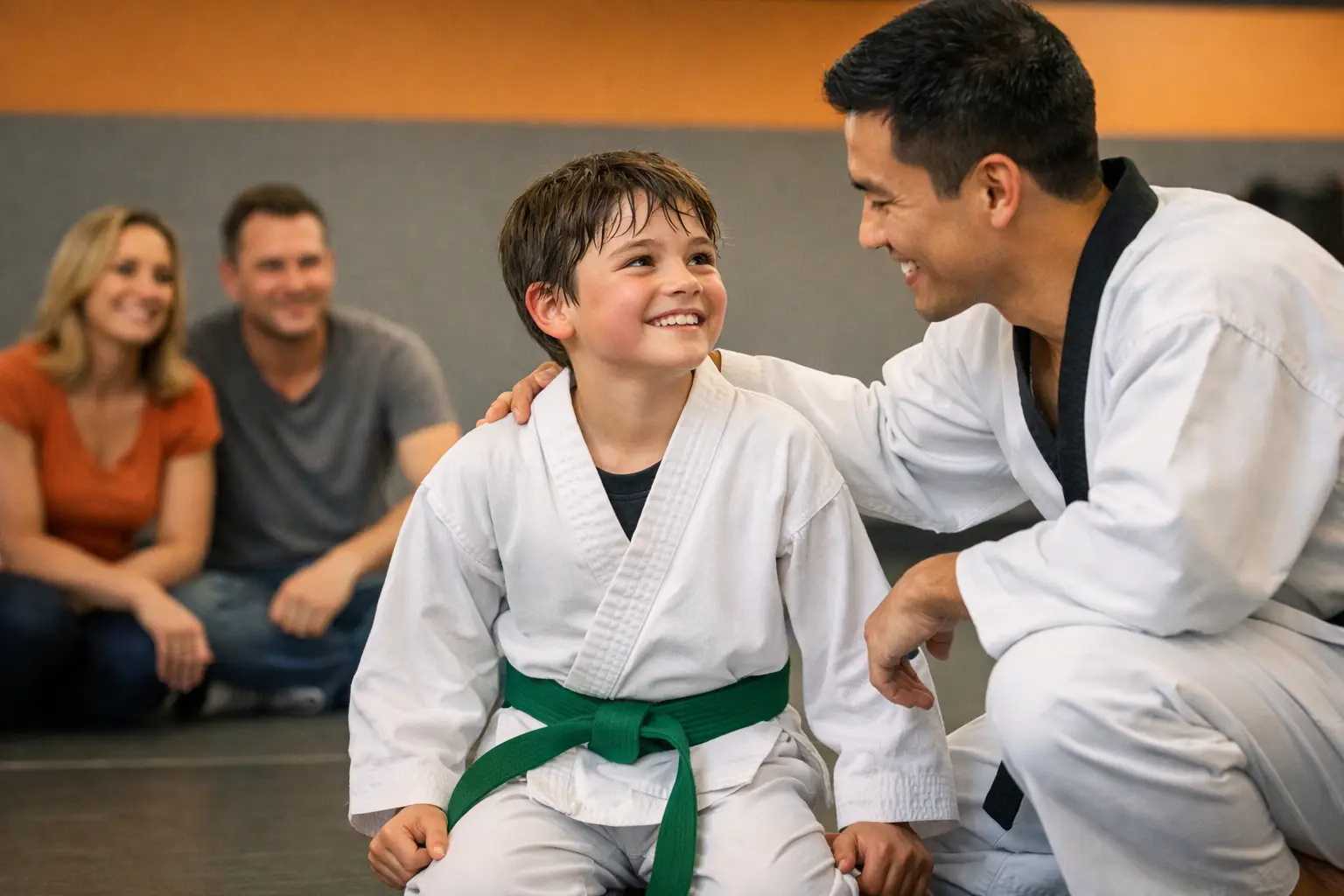
That matters because kids learn best when the lesson is attached to an experience. In martial arts, perseverance is not explained once and then forgotten. It is built into the structure. Students line up, practice, adjust, fall short, try again, and come back next class to keep working. Over time, they stop seeing struggle as proof they are failing. They start seeing it as part of getting better.
This is one reason martial arts can be so powerful for children who get discouraged easily. The mat gives them repeated chances to face something difficult without being left alone in it. They are coached through it. They are held to a standard. And they learn that frustration does not have to be the end of the story.
Progress is slow on purpose
One of the most valuable things martial arts teaches is that meaningful growth is rarely instant. Kids live in a world that often rewards speed. Fast answers, fast entertainment, fast results. Martial arts pushes against that.
A technique may take weeks to feel natural. Balance takes time. Timing takes time. Confidence takes time. Even students with strong ability still run into parts of training that humble them. That is not a flaw in the process. It is the process.
When a child stays with something long enough to improve, they gain more than a new skill. They gain evidence. They remember, I could not do this before, and now I can. That memory becomes a reference point later when school gets hard or emotions run high. They have lived through the gap between not yet and not anymore.
Of course, every child responds differently. Some need gentle encouragement. Some need firm accountability. Some need a little extra time before they feel comfortable struggling in front of others. Good instruction recognizes that perseverance is not built by embarrassing kids or pushing them past the point of trust. It is built by asking for effort, consistently, in an environment where growth is expected.
Setbacks stop feeling final
Every student has off days. They forget combinations. They get corrected again on the same detail. They lose a match. They freeze during a performance. What changes over time is how they interpret those moments.
At first, many kids read a setback as a verdict. I am bad at this. Everyone else is ahead. Maybe I should quit. With the right coaching, that mindset begins to shift. A mistake becomes information. A loss becomes something to study. A hard class becomes proof that they are being stretched.
That shift is huge for parents to see. You are not just watching your child get better at martial arts. You are watching them build a healthier relationship with difficulty itself.
Why earned progress builds stronger confidence
There is a kind of confidence that comes from praise, and there is a deeper kind that comes from evidence. Kids know the difference. When they have had to work for something, they trust it more.
Martial arts creates that kind of confidence because advancement is tied to showing up, applying corrections, and continuing when the early excitement wears off. A child who has repeated a skill until it finally clicks carries themselves differently. They are not confident because someone told them they are amazing. They are confident because they have proof they can do hard things.
That is especially important for kids who are used to feeling behind, misunderstood, or written off too quickly. Sometimes a child does not need another speech about potential. They need a place where effort turns into visible growth.
Perseverance is taught in the small moments
Parents often imagine growth happening in the biggest milestones, but perseverance is usually built in quieter ways. It shows up when a student fixes their uniform without being reminded and gets back into class. It shows up when they repeat a drill one more time after getting it wrong. It shows up when they lose composure, regroup, and rejoin the lesson instead of shutting down.
Those moments may not look dramatic from the outside, but they are where resilience starts taking root. Children do not become steady all at once. They become steady by practicing recovery.
That is why consistency matters more than intensity. One amazing class does not change a child. A pattern does. Week after week, they learn what is expected, what happens when they fall short, and what it feels like to keep going anyway.
The parent side of perseverance
There is another part of this conversation that matters. Kids are not the only ones learning perseverance. Parents are too.
If you have a child who struggles with frustration, confidence, or follow-through, you know progress is rarely a straight line. One week looks great. The next week feels like starting over. That can be discouraging. It can make any parent wonder whether something is working.
The truth is, real growth often looks uneven before it looks solid. A child may still have hard days and yet be improving in meaningful ways. Maybe they recover faster. Maybe they accept correction with less pushback. Maybe they do not storm away when something feels difficult. Those are real wins.
Families who stay the course long enough often notice the changes first outside the academy. A teacher comments that their child is sticking with assignments longer. Home routines get less combative. A child who used to avoid challenge starts approaching it with less fear. That is when perseverance has moved beyond the mat and into daily life.
How martial arts teaches perseverance without pretending hard things are easy
This matters because children can tell when adults are overselling. Hard things are hard. Training can be frustrating. Progress can feel slow. Not every class feels exciting. Not every student loves being corrected. Pretending otherwise does not help.
What helps is showing kids that hard does not mean hopeless. It means there is work to do. In a strong martial arts environment, students are not taught to avoid difficulty or mask frustration. They are taught how to move through it with support, structure, and accountability.
That is a different message than simple motivation. Motivation comes and goes. Perseverance is what carries a child on the days motivation is nowhere to be found.
And that is where families often see the biggest change. Not that their child suddenly loves every challenge, but that they stop running from every challenge. They learn to stay in the room. Stay in the rep. Stay with the process long enough to grow.
For many parents, that is the real goal. Not just a stronger kick or a new rank, but a child who starts believing that struggle is not a stop sign. It is part of the road. If your family is looking for something with substance, that lesson can reach much further than martial arts ever needed to.