
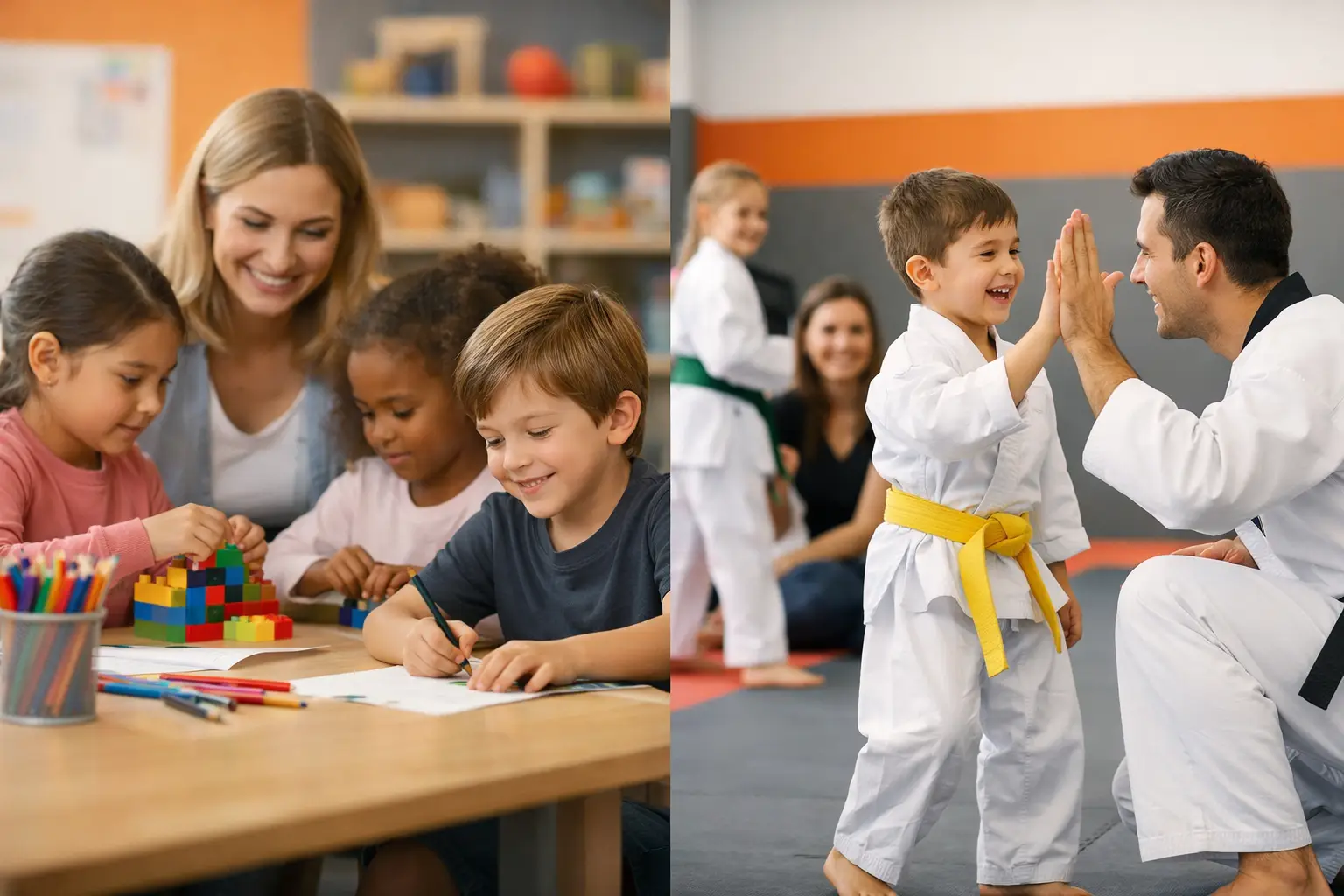
School lets out at 2 or 3 p.m., and that gap before dinner can shape a child’s whole day. For many parents, the question isn’t just who can watch their child. It’s afterschool care vs martial arts – and whether those hours will simply be covered or actually used in a way that helps their child grow.
That’s a different decision than most people think. On paper, both options can solve the same problem. A child is safe, supervised, and occupied until pickup. But once you look past the schedule, the real difference shows up in what your child experiences every afternoon, and what starts to change over time.
Afterschool care vs martial arts: what are you really choosing?
Most families start by comparing logistics. Hours, transportation, homework support, pickup times, and cost all matter. If you’re a working parent, those details are not small. They’re often the reason a program is even possible.
But if you stop there, you may miss the bigger question. Are you choosing coverage, or are you choosing development with coverage built in?
Traditional afterschool care usually centers on supervision and convenience. That can be exactly what a family needs, especially if a child is already thriving and just needs a safe, steady place to land after school. There is real value in consistency, free play, snacks, homework time, and a predictable routine.
Martial arts-based afterschool programs usually ask more of the child. The afternoon still includes the practical support parents need, but it also includes a structured training environment. Kids are expected to participate, listen, move with purpose, and work through challenges instead of avoiding them. For some children, that is where the shift begins.
When regular afterschool care is the right fit
It helps to be honest here. Not every child needs the same thing, and not every family is looking for the same outcome.
Regular afterschool care can be a strong option for parents who primarily need dependable supervision and flexibility. Some kids benefit from a lower-pressure environment after a long school day. If your child is emotionally spent by the time the last bell rings, a calmer setting with room to decompress may be the better choice.
It can also be a practical fit for families who want variety instead of one central activity. Some afterschool programs offer crafts, games, reading time, outdoor play, and homework help without requiring a child to stay engaged in one skill-building track.
That matters, because structure is helpful, but too much structure can backfire for certain kids. If a child resists highly directed environments and shuts down when the afternoon feels like more school, a broad aftercare model may work better.
The trade-off is that many traditional programs are built to manage a group, not necessarily to develop each child in a focused way. A child may enjoy the experience and still not come away with much change in confidence, self-control, resilience, or leadership. That doesn’t make the program bad. It just means the outcome is different.
What martial arts adds to the afterschool hours
When parents compare afterschool care vs martial arts, the biggest difference is purpose. Martial arts turns the afternoon into active growth.
A good martial arts program gives kids more than movement. It gives them a place where expectations are clear, effort matters, and progress is earned one step at a time. That rhythm can be especially powerful for children who have extra energy after school, who get discouraged easily, or who need a better outlet than screens and unstructured downtime.
The physical side matters, of course. Kids move. They train. They learn how to use their bodies with control. But the deeper value is what happens inside that structure. A child hears a direction, responds to it, practices it, struggles with it, improves, and sees that improvement for themselves. That cycle builds belief.
For many parents, that is the missing piece. They are not just looking for someone to fill time. They are looking for something their child can belong to and grow inside.
Martial arts is not just an activity
This is where some families make the wrong comparison. They think of martial arts as one more extracurricular, like adding a class onto an already busy week. But a strong afterschool martial arts program can function very differently.
It can solve the same transportation and supervision problem as aftercare while also giving a child a consistent framework. The child is not bouncing from school to babysitting to home. They are moving into a second environment with its own standards, routines, and supportive adults.
That matters more than people realize. Children often rise when the environment asks them to. They may be one version of themselves in school, another at home, and another entirely in a place that combines encouragement with accountability.
Parents usually notice the change in small moments first. Their child starts carrying themselves differently. They recover faster from frustration. They seem more steady. They are proud of effort, not just praise. Those shifts are hard to manufacture in a setting built mostly around keeping kids occupied.
The biggest question: what does your child need at 3 p.m.?
Some kids leave school tired and need a soft landing. Others leave school wound tight and need a productive release. Some need more social connection. Others need stronger boundaries and a place where follow-through is expected.
That is why afterschool care vs martial arts is not really a general parenting debate. It is a child-by-child decision.
If your child is doing well, enjoys free play, and simply needs a safe place until pickup, traditional afterschool care may be enough. Enough is not a bad word. Families do not need to turn every hour into optimization.
But if your child needs more structure than they’re getting, more confidence than they’re feeling, or a better way to channel energy and emotion after school, martial arts may be the stronger fit. Not because it promises instant change, and not because every child will respond the same way, but because it gives them something active to build on.
That difference is especially meaningful for parents who feel like they have already tried the easy options. When a child has bounced from activity to activity without finding the right fit, a program with clear expectations and real progression often lands differently.
What working parents should consider first
There is also the family side of this decision. The best program in theory is not the best program if it creates daily stress your household cannot sustain.
Transportation matters. Pickup windows matter. Whether homework gets started matters. Whether your child arrives home tired in a healthy way or overstimulated in a draining way matters too. Families in South Miami-Dade often need a solution that is both developmental and realistic, which is why programs that combine school pickup with meaningful afternoon structure can make such a difference.
This is one reason parents are drawn to programs like TUFF’s afterschool model. The support is practical, but the afternoon is not reduced to supervision. It is built around growth, leadership, and the kind of consistency families can feel over time.
Still, the best choice comes down to your child’s response. Visit the space. Ask what a normal afternoon actually looks like. Watch how instructors or staff speak to kids. Pay attention to whether expectations feel clear and whether the environment feels steady. Parents usually know quickly whether a place is just managing children or really helping them develop.
A better way to make the choice
Instead of asking which option sounds better, ask what result you want six months from now.
If the goal is safe coverage and a predictable afternoon, afterschool care may do exactly what you need. If the goal is for your child to become more confident, more engaged, and more grounded in how they handle themselves each day, martial arts may offer more.
Neither choice is automatically right. The right one is the one that fits your child honestly, not ideally.
And sometimes the clearest answer comes from one simple thought: after school, does your child just need somewhere to go, or do they need somewhere that can help shape who they’re becoming?