
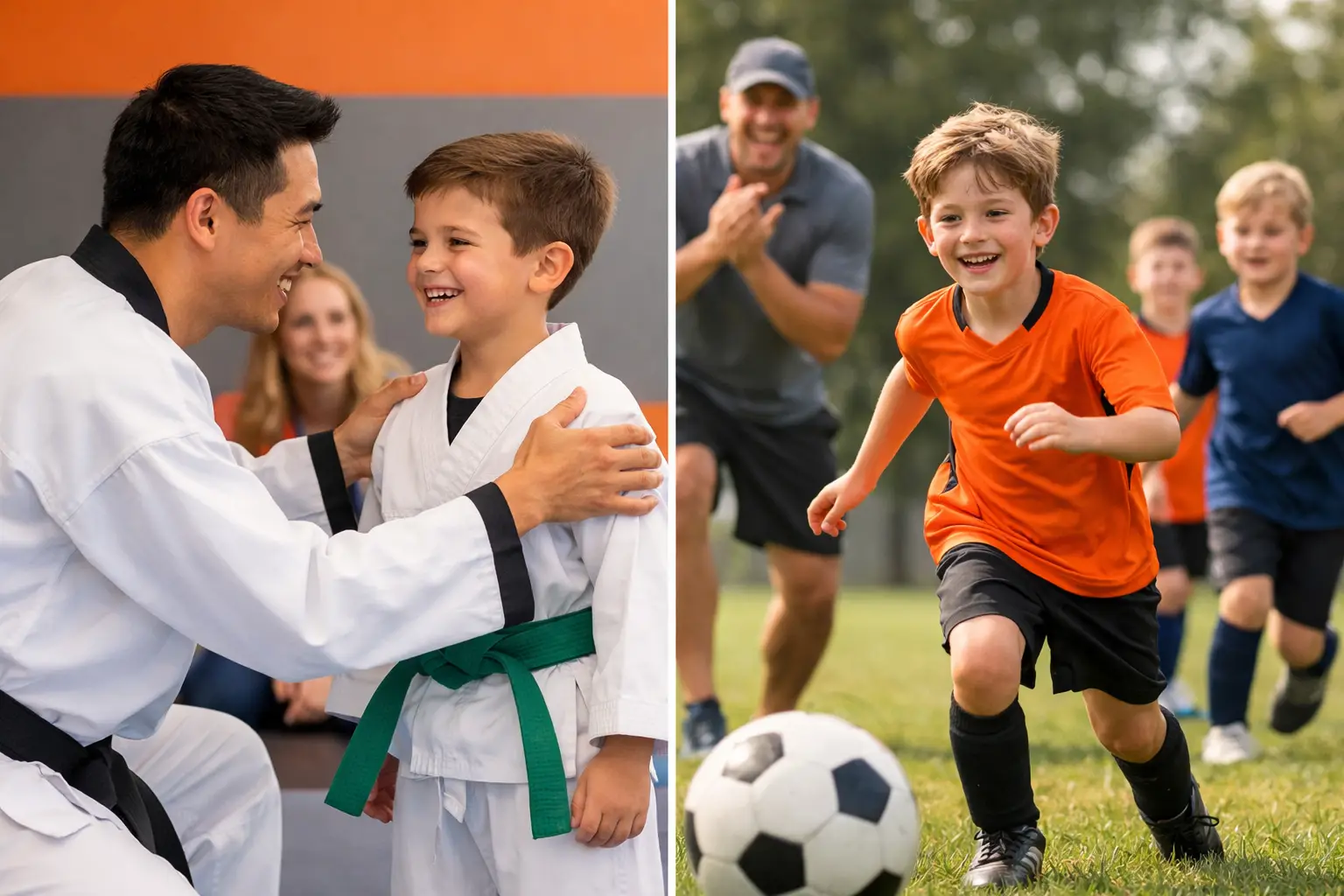
Your child may come home bursting with energy, shut down after a hard school day, or light up only when they are part of something bigger. When parents weigh martial arts vs team sports, they are rarely just choosing an activity for the calendar. They are trying to find the place where their child can feel capable, connected, and challenged in the right way.
There is no universal winner. Soccer, basketball, baseball, martial arts, and other youth programs can all give children meaningful opportunities to grow. The better question is not, “Which activity is best?” It is, “What kind of environment will help my child show up, keep trying, and carry progress into the rest of life?”
Martial Arts vs Team Sports Starts With the Child
Team sports and martial arts build different kinds of habits because the experience is different from the moment a child walks in. In a team sport, a child learns inside a group moving toward a shared result. They have teammates to encourage, coaches to listen to, positions to understand, and games where everyone’s effort affects the outcome.
In martial arts, a child is part of a class community, but they are also asked to take ownership of their own work. They practice a sequence until it improves. They stand in front of an instructor, receive correction, and try again. Their progress is visible over time, not because someone carried the ball for them, but because they kept returning to the mat ready to work.
For some kids, the energy and fast pace of a team environment is exactly what brings them alive. For others, a clearer routine and more direct feedback feels safer and more motivating. Neither response is wrong. It is simply useful information about what your child needs right now.
What Team Sports Can Give a Child
The strongest part of team sports is the shared experience. Children learn how to communicate when things are going well and when they are not. They learn that a teammate’s good moment can be worth celebrating, even when they wanted the spotlight themselves. They also see that preparation matters because other people are counting on them.
That can be powerful for a child who enjoys social energy and thrives when there is a group goal to chase. A child who loves game day, wants to be surrounded by friends, and bounces back quickly after a missed play may feel at home on a field or court.
At the same time, team sports can bring challenges that parents should consider honestly. Playing time may vary. A child can have a great week of practice but spend much of a game on the sidelines. The season may be short, schedules can change, and a child’s confidence can become tied too closely to the scoreboard or a coach’s decisions.
Those realities do not make team sports less valuable. They simply mean that a child who needs consistent participation, frequent coaching, or a steady weekly routine may need more than one practice and one game to feel grounded.
What Martial Arts Builds, One Class at a Time
Martial arts gives children something many parents are looking for: a place where effort has a clear next step. Students are not expected to get everything right immediately. They are expected to listen, practice, adjust, and return with a little more control than they had before.
That rhythm matters for children who have a lot of energy but need a constructive place to put it. It also matters for the child who hesitates to try because they worry about making a mistake. On the mat, mistakes are part of training. An instructor can correct a stance, ask for a stronger effort, or remind a student to reset after a frustrating moment. Then the child gets another chance right away.
Progress Is Personal, But Never Lonely
Martial arts is sometimes described as an individual activity, but a good program is deeply communal. Students train beside peers who are working through their own challenges. Older students can model what perseverance looks like. Younger students learn that they belong in the room before they are the best in the room.
The difference is that progress is personal. A child is not waiting for a turn in a lineup or hoping the game puts them in the right position. They are actively practicing throughout class. Over time, they can see the connection between showing up prepared, paying attention to details, and earning new responsibility.
That does not mean every child will prefer martial arts. Some children truly want the unpredictability of a game and the constant interaction of a team. But for a child who benefits from clear expectations, consistent movement, and the chance to measure growth against their own previous effort, martial arts can become much more than an after-school activity.
How to Choose Between Martial Arts and Team Sports
Start by watching your child outside of either activity. Do they talk most excitedly about being with friends, competing together, and playing a role on a team? Or do they seem proudest when they finally learn something that once felt difficult?
Also consider how they respond to feedback. A child who gets overwhelmed in a loud, fast-moving setting may do better in a class where instructions are repeated and routines stay familiar. A child who needs lots of social interaction may enjoy a team sport most, or may benefit from martial arts alongside a team activity.
Your family’s routine belongs in the decision too. Working parents often need more than a weekly practice. They need a reliable place for their child after school, with structure, movement, caring adults, and meaningful use of the afternoon. The best program is one your family can attend consistently, because consistency is where children begin to trust the process.
If possible, let your child try an introductory class or attend a practice before making a long-term commitment. Watch what happens when they walk in. Do they hold back at first but gradually engage? Do they leave talking about a specific skill they want to improve? Do they seem energized in a healthy way, not just exhausted? Those small observations often tell parents more than a brochure ever could.
Your Child Does Not Have to Pick One Forever
Children change. The quiet six-year-old may grow into a teenager who wants the excitement of a team. The child who spends every weekend on the field may eventually want a personal challenge that is not tied to a final score.
Many families find that martial arts and team sports can complement each other when the schedule allows. Team sports can teach children how to contribute to a shared outcome. Martial arts can give them a steady place to practice accountability, composure, and follow-through. The key is not filling every hour. Children still need room to rest, be bored sometimes, and simply be kids.
Parents should also resist the pressure to choose based on what other families are doing. A packed sports schedule may work beautifully for one child and leave another child drained. A martial arts class may be the place where one student finds confidence, while another sees it as a valuable foundation before returning to a favorite sport. Growth does not always follow the same path.
When the Afternoon Needs More Structure
For families in South Miami-Dade, the activity decision often comes with a practical question: who can get your child there after school? That is why programs that combine youth development with dependable after-school care can matter so much. A child has time to transition from the school day, move their body, complete responsibilities, and train in an environment where adults know their name and expect their best effort.
At TUFF Martial Arts, that commitment comes from lived experience. The school was built by a family that understood the search for a positive outlet firsthand, then created a place where children could be challenged, encouraged, and known. For working parents, dependable transportation and a structured afternoon are not extras. They are part of what makes a program sustainable.
The right choice is the one that helps your child leave each week a little more sure of what they can handle. Pay attention to where they are seen, where effort is noticed, and where they want to return. That is usually where growth has room to take hold.