
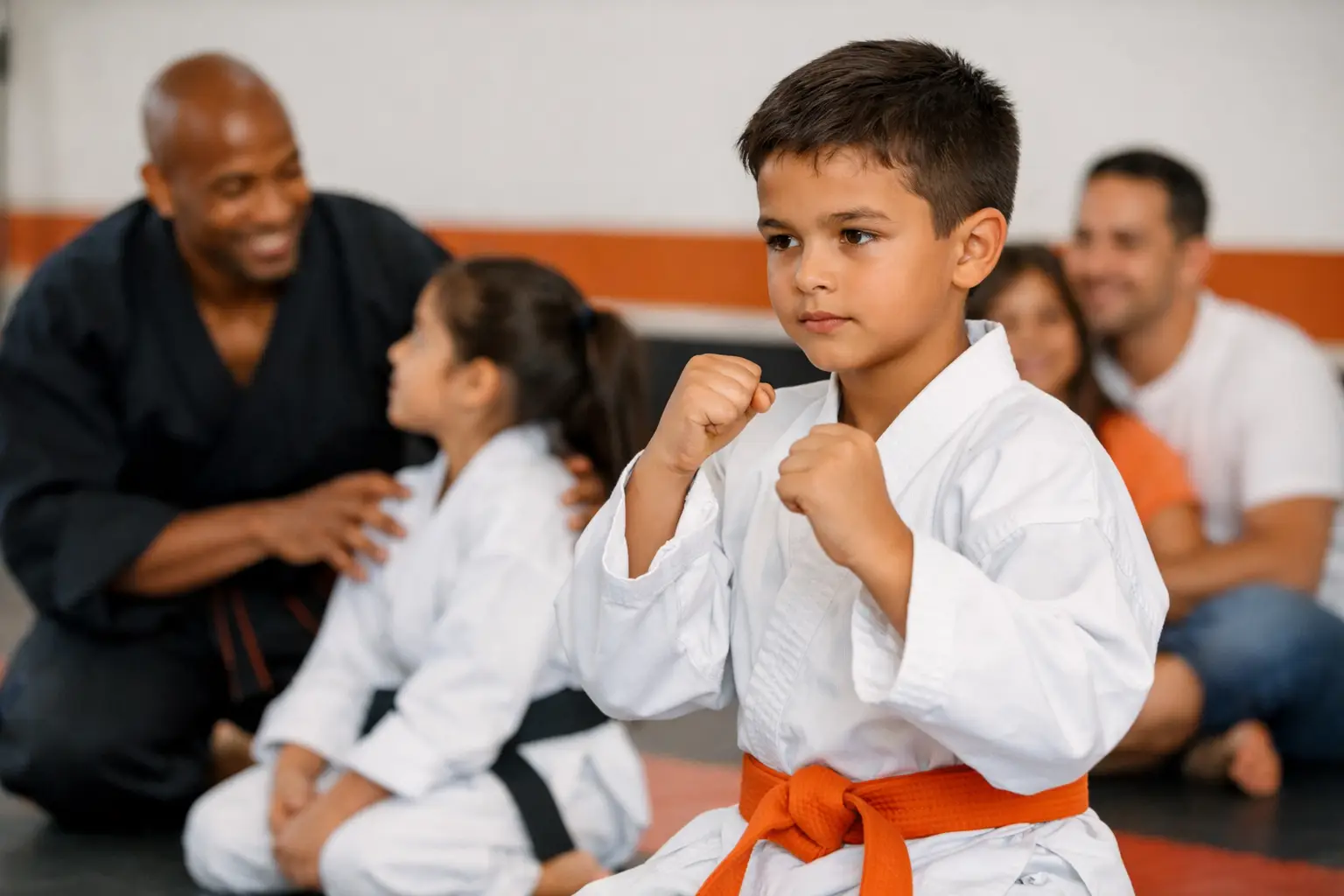
A lot of parents ask this question after a hard week, not out of curiosity. They ask it after another note from school, another homework battle, another afternoon where their child seems to have energy for everything except the one thing in front of them. Does martial arts improve focus? For many kids, it can – but not by magic, and not overnight.
What martial arts often does is give focus a place to grow. It gives a child a clear job, a structured environment, and repeated chances to practice paying attention with their body and mind at the same time. For some families, that becomes the first setting where they start to see a different side of their child.
Why martial arts can help attention click
A lot of kids do not respond well to constant verbal correction. If every day feels like, sit still, stop interrupting, pay attention, hurry up, they begin to tune adults out. Not because they do not care, but because they are hearing pressure more than direction.
Martial arts changes that dynamic. Instead of asking a child to focus in the abstract, it gives them something concrete to focus on. Watch the coach. Mirror the movement. Hold the stance. Count the reps. Wait for your turn. Reset and try again. That kind of attention is active, not passive.
For many children, especially the ones with big energy, that matters. Sitting at a desk and concentrating on a worksheet asks for one kind of focus. Standing on a mat, listening for instruction, controlling movement, and responding with purpose asks for another. Often, the second becomes a bridge to the first.
Does martial arts improve focus in every child?
Not automatically. And that matters for parents to hear.
A child does not become more attentive just because they put on a uniform twice a week. The environment has to be right. The instruction has to be consistent. The expectations have to be clear enough for a child to understand and strong enough for them to rise to.
Some children improve quickly because they love structure and respond to routine. Others take longer because they need time to trust the process. Some seem more focused in class before that same growth starts showing up at home or school. Progress is rarely a straight line.
That is why honest programs do not promise instant transformation. What they can offer is a setting where focus is practiced over and over in a way kids can actually feel.
What martial arts is really training
When parents think about focus, they usually picture concentration – staying on task, listening better, finishing what was started. Martial arts can support that, but it is also training a few deeper skills underneath it.
Attention control
A good class asks students to notice what matters and ignore what does not. There may be noise in the room, other kids moving, and plenty of reasons to get distracted. The student still has to track instruction, timing, and technique. That repeated practice builds better control over where attention goes.
Impulse control
Many kids know what they are supposed to do. The struggle is doing it in the moment. Martial arts creates constant moments of pause. Wait until you are called. Stop when told. Move with control, not chaos. Over time, that pause between impulse and action can get stronger.
Body awareness
Some children look unfocused when they are really just dysregulated. Their energy is all over the place. Martial arts teaches them how to organize that energy. When a child learns how to stand with intention, breathe, move, and reset, focus often improves because their body is no longer working against them.
Follow-through
Focus is not only about starting. It is about staying with something long enough to improve. Martial arts teaches kids that repetition is part of growth. They miss the move, try again, clean it up, and keep going. That process can build patience in children who are used to giving up the second something feels hard.
The structure matters more than the kicks
Parents sometimes picture martial arts as a child simply burning energy for an hour. Movement is part of it, and that helps. But the real value is not random activity. It is organized challenge.
The class has a beginning, middle, and end. There are rules. There are rituals. There is a standard for how students enter the mat, how they listen, how they partner, and how they respond when they make mistakes. That kind of structure can be especially powerful for kids who feel scattered in less predictable settings.
And there is something else parents notice. Kids often rise to expectations when those expectations are clear, calm, and consistent. They do not always need louder reminders. Sometimes they need a place where the boundaries do not move and the adults mean what they say.
Why some parents see changes outside the mat
When martial arts is working, the first signs are often small.
A child starts making better eye contact when someone gives directions. They recover faster after frustration. They interrupt a little less. They finish one task before jumping to the next. They begin to take pride in doing things the right way, not just the fast way.
That transfer does not happen because someone lectured them about being more focused. It happens because they have been practicing focus in a meaningful environment. They felt what success looked like. They experienced the connection between self-control and progress.
For working families, this can make a real difference in the rhythm of daily life. Homework can become less of a standoff. Mornings can feel less chaotic. Even when a child is still very much a child, there is sometimes a new sense that they can handle more than they could before.
What parents should realistically expect
If you are asking whether martial arts improves focus because your child is struggling right now, it helps to keep expectations grounded.
You may not see a total personality change. Your child may still be energetic, emotional, talkative, or easily excited. Martial arts should not erase who they are. The goal is not to make a child smaller or quieter than they were meant to be.
The better goal is growth. More self-control than before. Better listening than before. More ability to recover, redirect, and stay present than before. Those are real wins, and they tend to last longer because they were built, not forced.
Consistency also matters. A child who attends regularly, builds relationships with instructors, and spends time in a strong class culture is far more likely to benefit than a child who drops in occasionally. Like any developmental tool, martial arts works best when it becomes part of a routine.
Does age make a difference?
Yes, but maybe not in the way parents expect.
Younger children often show growth through simple habits first – lining up better, following multi-step directions, waiting more patiently, transitioning with fewer meltdowns. Older children may show it in more mature ways, like staying coachable under pressure, taking correction without shutting down, or sticking with hard tasks longer.
The timeline can vary, but the principle is the same. Focus improves when children are given repeated chances to practice attention, control, and perseverance in an environment that expects their best and believes they can reach it.
The role of the instructor is everything
This is the piece parents should never overlook.
A strong martial arts program is not just teaching technique. It is teaching children how to respond to challenge. That requires instructors who know how to hold standards without humiliating kids, correct behavior without shaming them, and build trust while staying firm.
Children can tell the difference between an adult who is just running a class and one who is invested in who they are becoming. That is often where the deepest growth happens. At TUFF Martial Arts Academy, that belief runs deep because the mission started in the same place many families start – with a parent looking for something real that could help their child grow.
So, does martial arts improve focus?
For a lot of kids, yes. Not because martial arts flips a switch, but because it gives focus practice, purpose, and accountability. It asks children to be present, to regulate themselves, and to keep trying when it would be easier to quit.
That kind of growth matters far beyond the mat. A child who learns how to settle their body, listen with intention, and stay with a challenge is building something bigger than attention span. They are building the foundation to lead themselves well.
If your child needs an outlet, more structure, or a place where their energy can be shaped instead of constantly corrected, martial arts may be worth looking at with fresh eyes. Sometimes focus does not improve because a child finally heard one more reminder. Sometimes it improves because they finally found an environment that taught them how.